
October and November: The Aurora Awakens
This is the shoulder season, and quietly one of the best times to come. The days are shortening fast, the first snows dust the Lyngen Alps across the water, and the darkness returns. Which means the Northern Lights return too.
October and November guests often have the landscape to themselves. The roads are clear, Tromsø's restaurants and cultural life are fully open, and the aurora season is underway. At Sommarbukt, the north-facing position over the fjord means you can watch from the sofa or the terrace without leaving the property.
At Sommarbukt in October and November, temperatures range from around -2°C to 8°C. Pack layers and waterproofs, and check clear-sky forecasts in the evening.
November to February: Peak Aurora Season
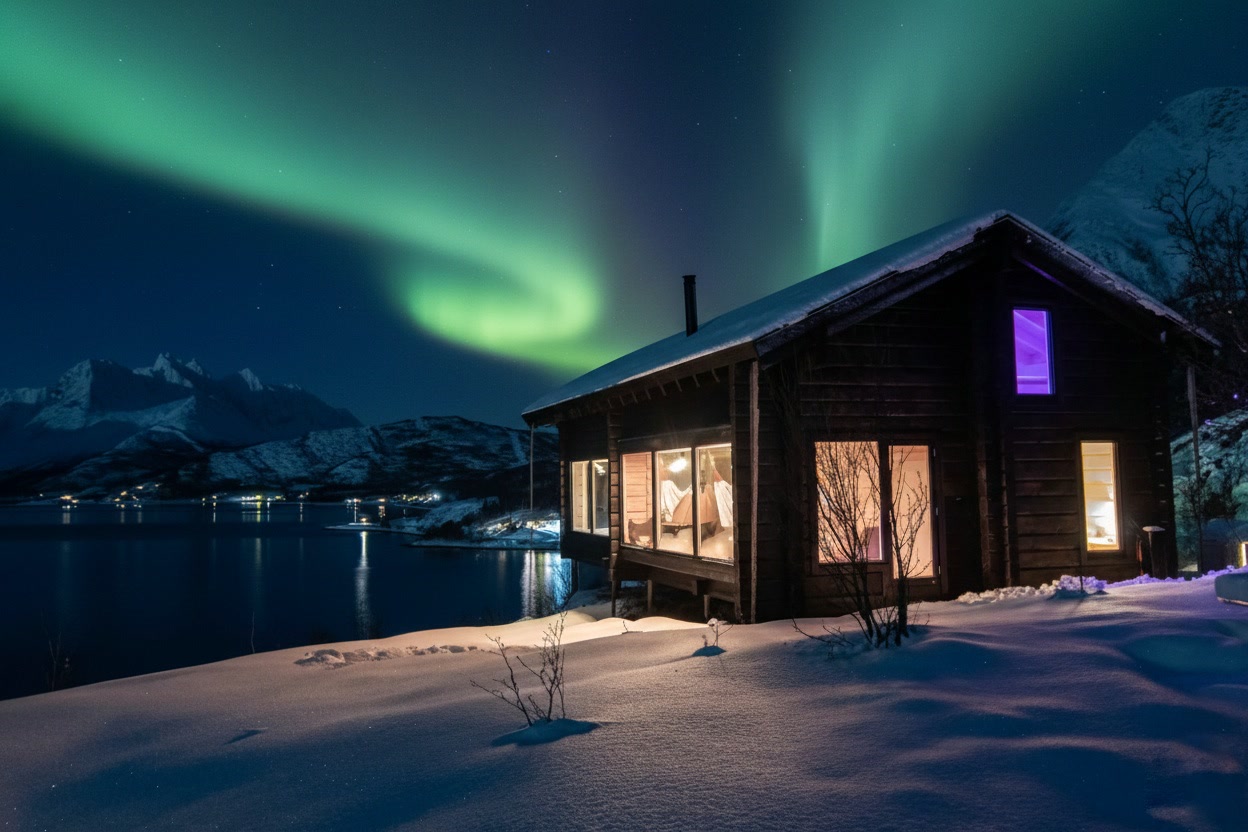
November through February is the best time to see the Northern Lights near Tromsø. This is the deep Arctic winter: at this latitude, the sun barely grazes the horizon for a few hours each day, leaving long blue twilights and dark nights well suited to aurora hunting. Snow settles over the dark timber of the cabins and the white slopes of the Lyngen Alps, and the fjord goes still.
The Northern Lights are at their most active and most frequently visible during these months. Sommarbukt's four cabins — Tind, Nordlys, Bjørka, and Skaret — all face directly onto the Ulsfjord, so guests often spot the aurora reflecting across the water without stepping off the terrace. Dog sledding, reindeer experiences with Sámi guides, and snowmobile tours are all available nearby through Tromsø Lapland and other operators.
Book well in advance. December and January fill quickly.
March and April: Light Returns, Snow Stays
March is a favourite for many guests. The polar night has ended, the days are lengthening rapidly, and the snow is still reliably deep. But you're gaining back the light. By late March, golden-hour light stretches across the Lyngen Alps for hours in the morning and evening.
The Northern Lights remain visible near Tromsø through March on clear nights; the aurora season ends in late March, and April marks the tail end of the window, with hiking and skiing opening up as conditions firm. The combination of snow-covered mountains, long spring days, and far fewer crowds makes March one of the most underrated times to book a cabin at Sommarbukt — the fjord views hold, the rates ease, and you're rarely competing for a spot on the terrace.
May to August: Midnight Sun
The midnight sun near Tromsø lasts from around late May to mid-July, and the sun does not set at Sommarbukt's latitude on the Ulsfjord during this window. The effect is disorienting in the best way: warmth at midnight, birdsong at 2 AM, the Lyngen Alps lit in a constant soft gold with no dusk to close the day.
Summer in the Arctic is short, intense, and green. Wildflowers cover the hillsides. The fjord is calm enough for kayaking. Tromsø comes alive with outdoor festivals and long evenings on the waterfront. Each of Sommarbukt's four cabins — Tind, Nordlys, Bjørka, and Skaret — comes with its own motorboat, so guests can explore the Ulsfjord on their own schedule, at midnight if they choose.
This is the season for guests who want warmth, activity on the water, and days that stop keeping time.
September: The Season Turns
September is brief, dramatic, and underappreciated. The birch trees turn gold against the dark mountains. The first aurora of the new season can appear as early as mid-September. Temperatures drop but the days are still long enough for hiking and outdoor activity.
It's also the quietest month at Sommarbukt. If you want the fjord and the four cabins nearly to yourself, with the landscape mid-transformation and the first hints of winter in the air, September is the moment.